Birder's Eye View

Saturday, January 1, 2011

Birding year in review

A poem. 

Another year has come and gone,
So here we are again.
Looking back at all we saw
In the year two-thousand-ten [2010!].

It started with the locals:
Palm warblers and Sandhill Cranes
Halfway around the world in back,
The year ended with just the same.

49 lifers from 4 different countries
Left much to be desired,
But between rooks and redshanks, ravens and wrens,
The journey was awe-inspired!

From guillemots to grey wagtails,
Europe showed me some new birds.
Red-crested pochards and chaffinches
Left me at a loss for words!

With 27 species total,
From England, Ireland and Wales,
After four months abroad,
I returned to the US trails.

In the Golden State for a month,
I learned my Western species,
From bushtits to Brandt's cormorants,
To California towhees!

31 was my California total,
With 17 life birds in all,
My favorite was the pigeon guillemot,
And the Heerman's gull.

Finally back in the Sunshine State
For school to start again,
It was back to the usual species,
Like the Carolina Wren.

But on breaks I saw some year birds,
Like harriers and wood-pewees,
And then I got a whole bunch more
On the local CBCs.

An old barred owl was my last bird
For the year 2010,
With 164 birds in all,
The year finally came to an end.

But I beat my goal of 150,
So I'm happy as you can see!
Good wishes for birding in 2011,
Hope it's as great is it can be!


Happy new year to all!

Labels: , , , ,

Tuesday, May 18, 2010

Home again

It's been over a month since my last post, but I am now back on US soil after nearly 4 months abroad. It's kind of strange to be back, but I must say it's a welcome change of pace from the chaotic city life.

Although I didn't really do any serious birding in the UK, I was surprised to find just now when I tallied up my list, that I actually saw nearly 40 species during the time I was there! It's a small number by most standards, but considering I wasn't even focused on birding, I'd say it's not too shabby. Here's the list, in no particular order, as I wrote it up mostly from memory:

1. Magpie
2. Rock Dove
3. Black-headed Gull
4. Wood Pigeon
5. Chaffinch
6. Great Tit
7. Coal Tit
8. Long-tailed Tit
9. Grey Wagtail
10. Mallard
11. Grey Heron
12. Red-crested Pochard
13. Mute Swan
14. Song Thrush
15. Tufted Duck
16. Blue Tit
17. Robin
18. Hooded Crow
19. Rook
20. Raven
21. Redshank
22. Brent
23. Guillemot
24. Great Black-backed Gull
25. Green Woodpecker
26. Canada Goose
27. Great-crested Grebe
28. Coot
29. Northern Shoveler
30. White-fronted Goose
31. European Starling
32. Eurasian Jay
33. Great-spotted Woodpecker
34. Common Moorhen
35. Cormorant
36. Wren
37. Carrion Crow
38. Buzzard
39. House Sparrow

There are probably a couple more I'm missing, but that's most of them.

Now that I'm back in the states, I definitely need to get back into the swing of birding again. It looks like my summer is getting a kick start this week though with the Bahama Mockingbird that showed up in Ft. Desoto! So I'll be heading down there this week to go find it, keeping my fingers crossed it hangs around for another few days.

More frequent updates to come! Until next time,

Happy birding!

Labels: , , , ,

Wednesday, March 31, 2010

Northern Ireland

As promised, here are the rest of my Irish birds from my recent backpacking trip. It occurred to me as I was uploading these that they were all taken in the same place -- at Colin Glen Forest Park. I did see many of these birds in other place, but I happened to photograph them all in the same place. The park, by the way, was excellent for birding!

Grey Wagtail. I was super excited to find this one -- it was foraging around in the fast-moving water for the longest time. Very cool bird!

Chaffinch. These were fairly common, although not easy to photograph. Neat looking little birds though.

Coal Tit. This was the only one of its kind I saw (or was able to ID at least!). More common were Great Tits and Blue Tits.

Wood Pigeon. These were *everywhere* and quite annoying too. Everytime I thought I saw a new bird, it was another Wood Pigeon...

Song Thrush. This bird offered us a great view, as it sat alone on a branch happily singing along to itself.

Not as many new birds in Northern Ireland as there were in the Republic, but it was a fun trip anyhow. Both countries were absolutely gorgeous, very friendly, and provided an overall totally amazing experience.

Now as spring is finally moving in to the UK I'll hopefully start seeing more things around London. I'll be visiting a few parks over the next few days, and in a few weeks if all goes as planned I'll be headed up into the mountains of Wales for some spring break backpacking.

Until next time,

Happy birding!

Labels: , , ,

Wednesday, February 10, 2010

Across the Pond

London is full of surprises. Just yesterday I was wondering when I'd ever have time to go birding, when little did I know that today I would find myself strolling through Hyde Park. Spontaneity is the name of the game here; at home I'm usually fairly organized and know what I'm doing from one day to the next, but here you kind of just throw a dart at a map and go.

As it were, today was one of the coldest days since I've been here. A few snow flurries here and there, but by midday it was just frigid and sunny out. I saw a bunch of the usual birds -- Pigeons, Magpies, and a Blackbird -- until we got closer to the lake, when I saw what looked like a woodpecker on a tree.

It was far away, but after snapping a few pictures, it was unmistakeable: a Green Woodpecker!
  
There were also tons of Black-headed Gulls, and some familiar North American waterbirds as well, including Canada Geese, Mallards and Moorhens.


Another fun lifer was the Great-crested Grebe. There were only a few of these in the pond, but they were very noticeable.

There were lots of these Red-crested Pochards as well, along with Tufted Ducks, Coots, and Northern Shovelers.

There were plenty of White-fronted Geese as well.

And FINALLY a European Starling in its native region! I've seen plenty of these back home, but it's far more fun to see them here in Europe where the belong.

Hyde Park has no shortage of birds, for sure. I also got to see my lifer Great Tit and Pied Wagtail there, too, unfortunately both of which were too quick and shy to allow for a photo. By then, I was also completely frozen and ready to get back into the warmer tube station and head home.

It was a wonderfully refreshing day though, and a nice escape from the bustling city for a few hours.

Until next time,

Happy birding!

Labels: , ,

Friday, January 22, 2010

Birding from beach to pond


On Thursday, my Field Ornithology class took a trip to Ft. Desoto to look at shorebirds. As luck would have it (and as luck apparently did have it for the last 4 years in a row!) it was THE windiest day we've had this month.

Once we made our way across the windblasted beach, we quickly became aware that there were a lot more birds out than one would have expected.  The first picture is of a Black-bellied Plover (defying its name in its winter plumage) and above are a bunch of Wilson's Plovers on some low dunes. Also present were Semipalmited Plovers, Willets, and Western Sandpipers.


I had two highlights for the day. The first was the above Reddish Egret in the whitish morph! We even got to watch it do its fishing dance. I got a video, but it was so windy and far away, the camera was too shaky. It was a lot of fun to watch though -- I wish we could have stayed longer.


My second favorite was my lifer Dunlin. I'm actually surprised I've lived here so long and never seen one, but there it is.

Today we took another field trip to the Suncoast Seabird Sanctuary. Although it's sandwiched in between towering condos and shopping centers, the facility takes in literally thousands of birds every year. It was great to see the work they're doing and get close-up looks at some of the birds we've been studying this past month.


I never thought about what a baby pelican would look like, but now I know! The little Brown Pelican chicks sitting under their mother reminded me oddly of little dinosaurs...


In addition to the plethora of rescued birds, there were also dozens of wild birds that had taken up residence in the trees and rooftops of the sanctuary, including this Black-crowned Night Heron.


After the field trip, I went birding at my usual spot on campus, and found a wide variety of species despite the somewhat unfavorable weather. Above is a juvenile Red-shouldered Hawk that I chased around for a bit trying to ID.

In addition to the usual wading birds and ducks, there were also some friendly passerines flitting around who  were (for a change!) not so camera shy! The above Pine Warbler came down to check me out while I was looking for the hawk, and below, a Blue-gray Gnatcatcher went on about his business foraging in a small tree.

It's been a great past few days. More birding to do this weekend and studying for the final.

Until next time,

Peace out!

Labels: , ,

Sunday, December 27, 2009

Christmas Bird Count time!

We started off as the early morning sun began to illuminate the overcast sky, three birders armed with binoculars and shivering slightly in the 48 degree dawn. The morning was kicked off spectacularly; as we opened the gate to the access road we would be covering in our route, a coyote stood in plain view right in front of us! Not a mammal you see too often down here, despite reports that their population is growing in the area.

On top of that, once we started hiking we came across a plethora of common warbler species.

"Yellow-rump!"

"Palm!"

"Pine!"

"Black-and-White!"

We called out, marking down the numbers. One of the members of our group had never done a CBC before, but the other member was quite experienced. I had never met either before, so it was fun to get to know them. Together, with our combined keen eyes and ears, we managed to find nearly a dozen species of birds right off the bat.

The first part of the trail was quite easy. It was little more than a wide access road with a few deep puddles that were easy to walk around. However, as we got deeper into the woods and turned off onto a less straight-forward route, the terrain got a little more difficult -- and wetter.

After about a mile of trekking, we found ourselves in the heart of the swamp. The deeply rutted trail had been transformed into a winding creek, identifiable only by the orange blaze markings on the trees and its distinct trail-like shape. Eventually, there was no dry ground in sight, and we had no choice but to get our feet wet.

It was cold. Oh boy, was it cold! And the further we walked, the deeper it got. We had also reached a "dead zone" of birds -- not a sound or a flutter of wings in the vicinity. Knee-deep in freezing cold swamp water, we sloshed along for a several hundred yards before finally reaching "dry" ground again. By now, "dry" was a relative term; the trail was soggy and squelchy, and most parts were flooded with a few inches of tea-colored swamp water.

We managed to add more birds the list. Titmice, robins, tons of catbirds, more warblers, and chickadees.

About half way through our route (about 2 miles in), we were nearly scared to death when the birder in front of me almost stepped on none other than an American Woodcock! It burst up from the palmettos peeping loudly and flew right over our heads, close enough to get a fantastic look at the strange creature. We were all ecstatic! It was a lifer for the other two birders, and a year- and state bird for me.

We hiked through about another half mile or so over water-logged trail. It was beginning to get shallower, which was quite the relief, because the air temperature had decidedly topped out at about 50 degrees for the day and we were all a little cold by now.

We stopped at one point to count a flock of butterbutts and titmice, when a different bird caught my eye. It was a vireo for sure, with distinct markings, but I couldn't come up with the name. One of the other birders whipped out a field guide and asked me what it looked like. There it was exactly: A Solitary Vireo! I felt a little silly for not having remembered the name, but then again, it was a lifer.

After that point, the trail was much drier. We headed out to the powerline corridor where we saw a bobcat (lifer mammal!) and a bunch of deer. We also heard some Eastern Towhees here and managed to find a Winter Wren in the marsh grasses.

We were almost on the home stretch by now, with about another mile to go. We still hadn't seen a Ruby-crowned Kinglet, one of the species we were expected to find in this area. The whole rest of the way we searched, but to no avail.

All in all, however, we found a grand total of 27 species. Not as big as the counts I did last year, but we managed to get some good birds (like the Woodcock) which count for something, at least in my book. :-)

It was a fantastic morning. 5 1/2 hours of hiking, about a mile of which was through the water. It was by far the coldest and wettest CBC I've ever been on, but definitely one of the most fun.

Until the next adventure,

Happy birding!

Labels: , , , , ,

Monday, July 27, 2009

This is the West!

"How very pleasant it is to be naïve enough to be excited by things which the natives of an area take for granted."
– Phoebe Snetsinger

I'm going to be M.I.A. from the blogosphere for the next few weeks, off on a journey out west.

With any luck, I'll be seeing American dippers, Western kingbirds, gray jays, ring-necked pheasants, mountain bluebirds, prairie falcons, black-capped chickadees, and a host of other lifers. Oh the joys of traveling as a "beginner" birder!

This will be my first trip to the midwest, and I can't wait to see what it's going to be like.

Until I get back,

Happy birding!

Labels: , ,

Monday, May 18, 2009

A wild Greater Sandplover chase, part 2

This is Part II. If you haven't already done so, please read Part I first! :-)
-------------------------------------------
Dave, Wes, and Erik wanted to know what other birds I needed for my list. I didn't have it with me (nor was I prepared for their generous offer to help me find whatever birds I needed!), so we decided to go after a Painted Bunting, since there were supposed to be a lot of them in the area.

As we drove down a narrow little road towards an old plantation, we stopped in front of a house with a plethora of feeders around it. There were tons of peacocks in the yard, but no buntings as far as we could tell. As we were inspecting the feeders from a distance with our binoculars, the homeowner came out and invited us into his back yard.

He said he had tons of Painted Buntings and other species that visited his feeders, but they come and go randomly (as birds often do). We didn't find any at his house, but when he learned we had been over to see the Greater Sandplover, he gave us an article about it that had come out in his local newspaper. He also showed us all of his peacocks (there were probably 20 or more strutting around on his roof, his car, in the bushes, etc).

It's amazing the interesting people you meet when birding! Just in that one day, we met people from all over the state and the country, talked to complete strangers who had fascinating stories to tell, and were all more than willing to help us in whatever way they could.

After leaving the peacock house, we went to the end of the road and birded around the plantation (really cool place, I wish I'd had more time to explore!). We ran into another birder we had talked to back at Huguenot, and she said she had seen a Painted Bunting back along the road where we had come from.

We headed back to the location she indicated. We stopped at one point along the way, and observed an American Redstart feeded a baby Brown-headed Cowbird. (I felt kind of bad for the Redstart -- the cowbird most likely pushed her babies out of the nest, but she will instinctively go on feeding it until it grows up).

Finally, we pulled over one more time and Wes played a tape of a Painted Bunting call. After a good 5 or 10 minutes, the bird swooped down out of nowhere and started chattering irritably at us.If at all possible, I was even more excited for the bunting than I was for the Greater Sandplover!
It wasn't exactly a lifer (I saw Painted Buntings when I was really little), but it was exciting to see it again and really appreciate it this time.

Wes, Dave and Erik asked what other birds I needed, and I mentioned that I didn't have very many sparrows, so we decided to grab lunch and then find some pine forests in which to go look for a Bachman's Sparrow.

We went to a park called Haw's Creek, but it was overgrown with scrub and the wrong kind of habitat for sparrows. Plus, by now there were thunderstorms all around us and it was raining off and on, so we decided to take a quick break and then head back across the state. Before we left, we did manage to see a female Ruby-throated Hummingbird feeding on some trumpet vine flowers over the parking lot, which was a fun treat.

As we headed back west, we saw quite a few Swallowtail Kites flying over the road. When we drove under three of them together -- a juvenile and two adults -- we pulled over and Wes brought out his bird call tape.

The Kites doubled back and flew towards us, swooping in low and turning their heads inquisitively towards us to figure out what the sound was.

It was really cool to see them up close. They seem like very curious birds; after a while, two of them lost interest, but the third one hung around for a bit, still trying to figure us out.

In that one trip, I got 12 year birds, 7 lifers, and an unforgettable experience.

On the way back, driving through rain and thunderstorms, Wes and Dave told more tales about their birding adventures.

Once again, I am simply in awe of the incredible people I've met through birding. How amazing it is that three random folks who I don't even know would offer to take me across the state, show me new birds, and share their fantastic stories and wealth of knowledge.

I am infinitely grateful to Wes, Dave and Erik for taking me along on their great adventure, and putting up with my newbieness and ornithological ignorance. I am also indebted to my mom for getting up at 4am for me, tolerating my insanity, and supporting me in this wonderful journey. I can never thank you enough!

Until next time,

Happy birding!

------------------------------

To see the rest of my photos from the trip, click here.

Labels: , , , , ,

Saturday, February 21, 2009

Life bird and other animals

Today I went to see the manatees that come every year to the warm water discharge canals at a nearby power plant.

I haven't seen a manatee in a long time, so it was a lot of fun. There were at least a hundred of them (probably more, even) swimming around in the canal.

I also saw a life bird! It was really far away and I didn't have my binoculars with me, so I took a bunch of pictures and IDed it when I got back. Correct me if I'm wrong, but it looks like we have a Spotted Sandpiper!

The shorebird isn't in breeding plumage, but it does have a couple spots on the under belly. It also seemed to bob its tail a lot when it walked.
If it's possible to have a "life fish" (as opposed to a "life bird," of course) this sting ray would be one of them! I have never seen such a sea creature before -- the Spotted Eagle Ray's fins spanned at least 4 feet across and its tail was over 5 feet long. It was just swimming in circles in front of the nature boardwalk.

I also saw a couple of bonnet head sharks chasing fish around near the manatees. These, too, were nearly 4 feet long.
Today was a lot of fun. I didn't see many birds besides the lifer, but it's always great to see new animals in general.


Happy birding!

Labels: , ,

Sunday, February 15, 2009

Oh, right! The GBBC!

College has this fantastic way of blurring the days together such that you lose yourself in the academic world, and neglect to nurture your need for the quiet solitude of nature.

Well, this morning I realized that when I woke up thinking about the Great Backyard Bird Count. It occured to me that I missed its first two days! I threw my birding gear into a bag and took off down the road on my bike to my favorite birding spot on campus.

It was still early enough for many birds to be roosting in the oak grove and around the pond. After tallying up the many vultures blinking sleepily at me from their perches, I turned my attention to the multitude of Lesser Scaups floating around in the water.

There seemed to be two seperate flocks of them, totalling 34 individuals.

There were also quite a few Mottle Ducks swimming around, as well as Coots and Moorhens.


I had never seen the above duck before, so it wasn't until I got back to my dorm and looked it up that I realized I had seen a beautiful male Blue-winged Teal! That's a lifer. Very cool duck, and one I definitely wasn't expecting to see.

It was a delightfully refreshing hike around the pond and through the oak grove, and a good reminder to myself that I need to take a break from college sometimes and make some time for myself.

Well, until next time,

Happy birding.

My GBBC report:

Observation Date: FEB 15, 2009
Start Time: 9:30 AM
Total Birding Time: 1 hour
Party Size: 1
Skill: good
Weather: good
Habitat(s):
-coniferous woods
-scrub
-suburban
-freshwater
-salt water
Number of Species: 25
All Reported: yes
Checklist:
Mottled Duck - 8
Blue-winged Teal - 1
Lesser Scaup - 34
Brown Pelican - 2
Double-crested Cormorant - 30
Anhinga - 5
Great Egret - 2
Snowy Egret - 1
Roseate Spoonbill - 1
Wood Stork - 1
Black Vulture - 20
Turkey Vulture - 12
Osprey - 2
Common Moorhen - 3
American Coot - 3
Laughing Gull - 16
Ring-billed Gull - 1
Rock Pigeon - 3
Monk Parakeet - 2
Blue Jay - 1
Fish Crow - 6
Blue-gray Gnatcatcher - 1
Northern Mockingbird - 1
Palm Warbler - 12
Northern Cardinal - 1

Labels: , , ,

Friday, January 2, 2009

after-Christmas Bird Count

"Birding, after all, is just a game. Going beyond that is what is important."- Roger Tory Peterson

I just spent the last 8 hours or so on my second Christmas Bird Count. This one was at a different park than the last one, but the procedure was more or less the same for the first few hours.

As the 5 of us in our group hiked out into an open field, the sun rose in a great burst of peach and orange rays off to our left. As it rose, the sky filled with a bubbly, chortling chorus of birdsong. Looking up, we observed a seemingly endless river of Tree Swallows flying south-west above us.

We counted them for what seemed like an eternity, and by the time they finally disappeared from sight, we had counted 409 of them. Not only did these count as year birds for my list, they were also lifers as well!

Further down the trail through the field, we stopped to try and identify some sparrows. This area was apparently known for its wide variety sparrow species, but the little birds proved impossible to ID, even by the experienced birder in our group.

After about an hour (perhaps a little less), we came to an area where there had been reports of an American Kestrel. Just as one of the birders was telling us this, I saw one land on top of a tree, and quickly pointed it out.

Kind of funny, I seem to be the one that has found the American Kestrel on both the CBCs I've attended so far. (Well, at least I'm good for something!)

Not far past the Kestrel, we found feathers from some kind of medium-sized black and white bird. Unfortunately, we weren't able to ID it, so we took some photos to look at them closer later on. I have a couple ideas of what it could be, but nothing I'm willing to bet on yet.

Hiking down another trail, we picked up some Eastern Towhees, a Swamp Sparrow (finally!!)Carolina and House Wrens, tons of Palm and Pine Warblers, Sandhill Cranes, and a few Tufted Titmice among other species.

At one point, we went along a bike path in search of a Brown-headed Nuthatch. I was especially eager to find this bird, as it would be another lifer for me. Just as we were nearing the very edge of our assigned CBC area, one of the birders spotted it. I got a brief, but sufficient look at the Nuthatch before it flew off.

Traveling around to different areas, we also picked up a Blue-headed Vireo, Blue-gray Gnatcatchers, Red-shouldered Hawks, a couple Ovenbirds, over 200 Robins, three different species of Woodpecker, and even heard a couple Barred Owls.
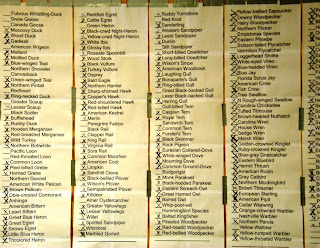
After lunch, we drove back to the education center where all the CBC groups were gathering to turn in their midday reports. Most seemed to be leaving by the time we got there, but there was still a significant number of birders milling about. The above picture is of a giant checklist taped to the wall of all the birds that had been seen that morning (I was really bummed out to find I my photo cut off the last panel of the checklist! :-().

The man in charge of this CBC was intent upon checking off every single bird, and was sending out groups to find certain target species. It was then that I realized how competitive this Audubon chapter was, and how they had managed to have allegedly gotten so many local records in the past.

After turning in our reports, we were getting ready to head out again, when a reporter for the local newspaper walked up to me and asked if I was "the college student."

Oh god, I thought, my heart sinking. I hate reporters. I did a lot of journalism in high school so I do have sympathy for them, but I hate being the interviewee.

After having to carefully spell out my name for him, he asked me various questions about how long I had been birding, how I got into it, my favorite birds had I seen today. At this last question, I was not feeling too happy about being interviewed, and I drew a complete blank.

"Nuthatches," I said off the top of my head, feeling myself blush. "Uh, Brown-headed... Nuthatches. And an American Kestrel. I like those."

Real smooth, I thought to myself. Just blurt something out.

The reporter and his photographer decided to follow our group for a little while, so we headed out around the education center. We didn't see much, and after about 15 minutes we came back out to the parking lot, at which point the journalists left claiming they had everything they needed. I guess we'll see -- I might be in the newspaper in a couple weeks! It'll be interesting to see what the article is like when it comes out.

After that little adventure, we birded for another couple hours. We found more Palm and Pine Warblers, like those in the picture above, and I and another birder even heard a Bald Eagle in the distance. One of our last birds we saw as we were heading out was another lifer for me -- a Ruby-crowned Kinglet.

Our final list count was 45 species, which I would say is a pretty good start for the year!

Until next time,

Happy birding!

Labels: , , , , ,

Sunday, December 21, 2008

Christmas Bird Count

6:30am this morning, I was driving down windy, rural roads in the inky blackness of pre-dawn, squinting through the dense fog. I could hardly see 10 feet in front of the car, and the windows kept clouding up. I hate driving. But if it gets me to a good birding spot, I'm game.

By the time I arrived at the preserve's research center, the sky was beginning lighten, just a little. When I got into the building, there were about 15 birders inside. I signed in, was introduced to people, and after a few minutes, we were all given the run-down on how the CBC would play out.

There were 4 people in my group; one woman who had only been interested in birds since the spring, a man who had been birding for about 3 years, and another birder I had met last year.

Strapping on my binoculars, camera and water bottle, I followed my group out to one of their cars, and we drove to the education center trail, our assigned area.

By then, it was beginning to get light outside, but the fog was still fairly heavy, muting all the sounds. Nonetheless, we picked up several Gray Catbirds, butterbutts, and Carolina Wrens on our first couple stops.

Everything was covered in a blanket of dew. Water droplets sparkled like little twinkling stars caught on the tips of the pine needles. It was a beautiful morning, even for all the fog.

Eventually we parked the car and began hiking our assigned trail. Before we even left the parking lot, I pointed out an American Kestrel that gave us a tremendous aerial display. It was shrieking and swooping about, a dull silhouette in the gray sky.

From there, we saw many more common species, as we entered the powerline strip. On two side-by-side towers, we counted 156 Black Vultures roosting. Not far past that, a Cooper's Hawk flew right over us, counting as a life bird for me.
Next, we followed a trail that two of the birders called something like "Web Alley," for the hundreds of spiderwebs spun in the surrounding foliage. I wasn't looking forward to walking through this area (spiders and I don't tend to get along so well), but was delighted to see the small, intricate webs covered with little beads of dew. When the sun began to shine a little, the spiderwebs glittered.
In this area, we counted American Crows, Palm Warblers, a Great Blue Heron and Great Egret, as well as several other species.
As we came out of Web Alley, the other birders noted that Eastern Towhees could be heard calling in the distance (another lifer!). We couldn't confirm any sightings, but we were able to count them by sound.

We saw many woodpeckers, including the above Red-bellied, which posed obediently in front of us for a while.

Some hotspots we found were swarming with Palm, Pine, and Yellow-rumped Warblers, Tufted Titmice, and I even identified an Eastern Pheobe flitting around in some trees.

It took us about 4 hours to complete our route, and we finished with a grand total of 30 species. I was hoping to see more, but considering we had one of the shorter routes, I suppose it wasn't too bad.

After having done this, I'm eager to participate in more CBCs. It was a ton of fun, I got to meet some cool people, and see a couple new birds. There's another CBC in January that I'm going to try to attend at another nature park, which I have heard is far more competitive. I say, bring it on!

Happy birding!

Labels: , , ,

Sunday, November 9, 2008

Birding update

After a short hiatus from Project Feederwatch, I have begun collecting data again. I was surprised to find the significant increase in species this week than there had been just a couple weeks ago when we started the preliminary surveys. It is clear that migration is coming in full swing.

On Tuesday, when I was getting ready to leave after a couple hours of feederwatching, I looked behind me at the pond and saw a large, striped wading bird disappearing into the reeds.

Bittern! I thought immediately. I have never seen a Bittern before, but I remembered seeing pictures of them in my guide. I grabbed my backpack and camera, and clambered through the knee-high grass that grew on the bank, trying to ignore the large spiders that scuttled up their webs nearby.

There was another birder there as well, and she approached the reeds from the other side. We heard a crashing about, and all of the sudden the bird launched itself to the top of the reeds and froze in a strange position with its wing outstretched. (We figured out that the bird was playing dead, after a few moments of inspection)

It was a Bittern! An American Bittern, to be exact. I snapped bunch of pictures, and then felt guilty for scaring it, so we left it alone.

On Friday, I had another close encounter with a large bird. It was 7:30am and I was having breakfast in the common room of my dorm. I was sitting by the window (watching birds, of course), when I noticed a large avian flying towards the window.

Its wingspan was big enough to be a Great Blue Heron, but it had a short neck. As it got closer, closer, closer -- so close I held my breath, sure it was going to smack into the window -- I realized it was a Bald Eagle!

The bird was less than 10 feet away outside the window when it pulled up and soared right over the building, right in front of me. I have never seen a wild Bald Eagle so close before, much less watched in flight -- at eye level.

Well, needless to say, it was a good week for birding. I saw a couple year birds, a life bird (the Bittern) and a spectacular view of a Bald Eagle.

I'll post pictures later.

Happy birding!

Labels: , , , , ,